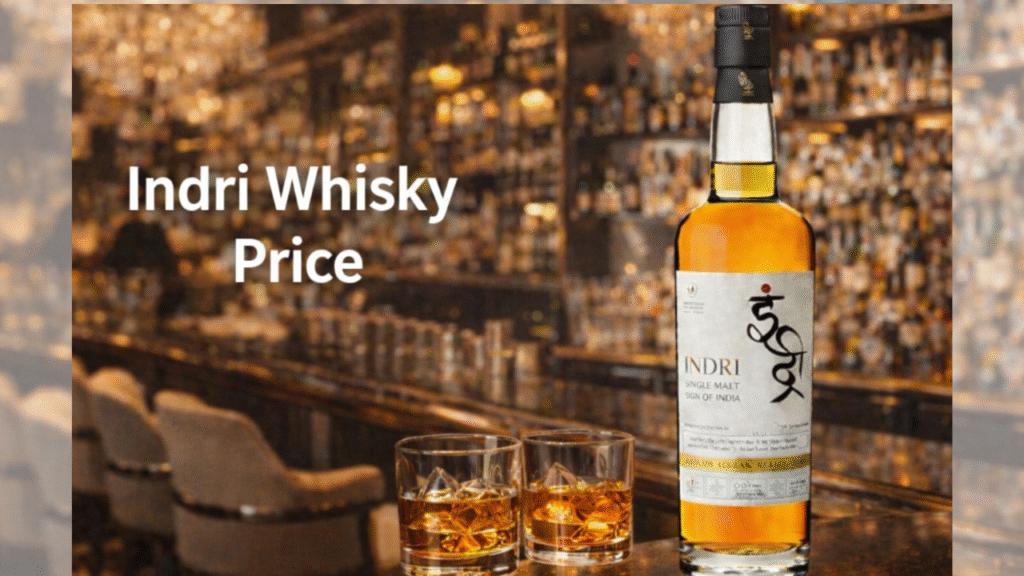
Indri Single Malt Whisky has established a reputation as one of the best premium Indian whiskies and enjoys appreciation by whisky enthusiasts in India. However, the Indri Whisky Price 750ml is highly different in other states of India due to differences in taxation and excise duty. Most buyers are looking for the real price before buying from a retail store, an online shop, or a duty-free shop.
Indri Whisky is made by Piccadilly Distillery in Haryana, India. It is associated with the town of Indri, near the basin of the Yamuna River. The special climate in the area means that you end up with rich and flavourful whisky at a faster rate. Since its inception, Indri has been awarded internationally and recognised in the global spotlight for Indian Single Malts.
Indi is the country’s inaugural triple-wood matured single malt whisky. Matured in ex-wine, French oak, and Pedro Ximénez casks, it has a creamy mouthfeel, which is accompanied by sweet fruity notes on the palate and soft smoky nuttiness to finish. As its preparation is also premium, the Indri whisky price in India 750ml, falls under the category of Premium Whisky. It is imported in a 750ml bottle, and that size is the most popular size available all over India.
English;How Bestbettingph Explains Football Betting Basics for Filipino Beginners;https://bestbettingph.com/;at Bestbettingph
How Bestbettingph Explains Football Betting Basics for Filipino Beginners
Football is the most widely followed sport in the Philippines, and with the expansion of regulated online sports betting platforms since the Philippine Amusement and Gaming Corporation (PAGCOR) began issuing electronic gaming licenses in the early 2000s, more Filipinos than ever are exploring ways to engage with the game beyond simply watching it. For many beginners, however, the gap between understanding football as a sport and understanding football betting as a structured activity can feel significant. The terminology is unfamiliar, the formats vary between platforms, and the mathematics behind odds can seem opaque without proper guidance. This article walks through the foundational concepts of football betting as they are typically explained to Filipino newcomers, covering odds formats, common bet types, bankroll principles, and the regulatory environment that shapes legal betting in the country.
Understanding Odds Formats and What They Actually Mean
The first barrier most Filipino beginners encounter is the odds display itself. Unlike the scoreboard of a football match, odds are not self-explanatory — they encode both the implied probability of an outcome and the potential return on a wager, and they do so in formats that vary depending on the platform and its regional orientation.
The three formats a Filipino bettor is most likely to encounter are decimal odds, fractional odds, and American (moneyline) odds. Decimal odds are by far the most common on platforms serving Southeast Asian markets, and they are also the most mathematically straightforward. A decimal odd of 2.50 on a team winning means that for every peso wagered, the bettor receives 2.50 pesos back if the bet wins — this includes the original stake. The net profit is therefore 1.50 pesos per peso staked. To extract the implied probability from a decimal odd, you divide 1 by the odd: 1 ÷ 2.50 = 0.40, or 40%. This means the bookmaker’s model assigns a 40% probability to that outcome occurring.
Fractional odds, more common on UK-facing platforms, express the profit relative to the stake rather than the total return. Odds of 3/2 mean that for every 2 pesos staked, the profit is 3 pesos — total return is 5 pesos. Converting to decimal: (3 ÷ 2) + 1 = 2.50. The two formats are mathematically equivalent; the presentation simply differs. American odds use a different convention entirely, expressing how much must be staked to win 100 units (when negative) or how much is won from a 100-unit stake (when positive). A line of -150 means staking 150 pesos wins 100 pesos in profit. A line of +200 means staking 100 pesos wins 200 pesos in profit. Filipino beginners who primarily use PAGCOR-licensed or Philippine Offshore Gaming Operator (POGO)-adjacent platforms will most commonly see decimal odds, but familiarity with all three formats is useful when comparing lines across different operators.
One concept that receives less attention in casual introductions but is critical for anyone serious about betting is the overround, also called the vig or juice. Bookmakers do not offer odds that sum to exactly 100% probability across all outcomes — they inflate the implied probabilities so that the total exceeds 100%, ensuring a margin regardless of which outcome occurs. In a typical two-outcome football market (home win, away win, or draw treated separately), a bookmaker might price the three outcomes such that the implied probabilities sum to 105% or 108%. That excess percentage represents the bookmaker’s built-in edge. Understanding the overround helps bettors evaluate whether a particular market is competitively priced and why long-term profitability requires finding situations where the bettor’s own probability assessment diverges favorably from the bookmaker’s implied probability.
Common Bet Types in Football and How They Are Structured
Once a beginner understands how to read odds, the next step is understanding what can actually be wagered on. Football offers a wider variety of bet types than almost any other sport, and the terminology used across platforms — even those serving the same market — is not always consistent. Breaking down the most common structures helps clarify what each bet is actually measuring.
The match result, also called the 1X2 market, is the most basic wager: a bettor selects whether the home team wins (1), the match ends in a draw (X), or the away team wins (2). This bet is settled on the result at the end of 90 minutes plus referee-added stoppage time, not including extra time or penalty shootouts unless the platform explicitly states otherwise. This distinction matters particularly in knockout competitions like the AFC Champions League or the FIFA World Cup, where matches can extend beyond regulation.
The Asian Handicap market is especially popular across Southeast Asia, including the Philippines, because it eliminates the draw outcome and provides more granular pricing on matches between unevenly matched teams. In an Asian Handicap market, the stronger team is given a negative handicap (e.g., -1.5 goals) and the weaker team a corresponding positive handicap (+1.5 goals). A bettor backing the favorite at -1.5 needs that team to win by two or more goals for the bet to succeed. Quarter-ball handicaps (e.g., -0.75 or -1.25) introduce a split-stake mechanism where half the wager is placed on one full handicap and half on the adjacent half-ball handicap, which can result in a half-win or half-loss outcome. This structure is initially confusing for beginners but becomes intuitive with practice.
Over/Under markets, sometimes labeled Goals markets, ask bettors to predict whether the total number of goals in a match will exceed or fall below a specified threshold — most commonly 2.5 goals. A bet on Over 2.5 wins if three or more goals are scored across both teams. These markets are popular because they remove the need to predict which team wins and focus purely on the tempo and scoring nature of the match. Platforms covering Philippine football audiences frequently offer Over/Under lines not just for full matches but for individual halves, which creates additional betting opportunities within a single fixture.
Both Teams to Score (BTTS) is another widely available market that asks simply whether both sides will score at least one goal each, regardless of the final score. A 2-1 result, a 3-2 result, and a 1-1 draw all result in a BTTS Yes outcome. Correct Score markets, by contrast, require the bettor to predict the exact final scoreline and carry correspondingly higher odds due to the difficulty of precision. Accumulator bets, known colloquially as parlays in some markets, allow bettors to combine multiple selections across different matches into a single wager where all selections must win for the bet to pay out — the odds multiply across selections, creating the potential for large returns from small stakes, but also significantly increasing the probability of losing.
Resources that explain these structures in a practical, locally contextualized way are valuable for Filipino newcomers. The kind of systematic breakdown found at Bestbettingph, where these concepts are organized with Filipino bettors’ specific platform environment in mind, helps bridge the gap between abstract definitions and the actual interface a bettor encounters when placing a wager on a PAGCOR-licensed site or a regulated offshore platform.
Bankroll Management and the Mathematics of Sustainable Betting
Understanding bet types and odds is necessary but not sufficient for responsible and sustainable engagement with football betting. The discipline that separates recreational bettors who remain in control of their finances from those who encounter problems is bankroll management — a set of principles governing how much to stake on any given bet relative to the total funds allocated for betting activity.
The foundational principle is stake sizing. A common approach among experienced bettors is the flat staking method, where a fixed percentage of the total bankroll — typically between 1% and 5% — is wagered on each bet regardless of confidence level or perceived value. If a bettor’s bankroll is 10,000 pesos and they use a 2% flat stake, each bet is 200 pesos. This approach limits the damage from losing streaks, which are statistically inevitable even for bettors with a genuine edge, and prevents the psychological trap of chasing losses by increasing stake sizes after a string of defeats.
A more sophisticated approach is the Kelly Criterion, developed by mathematician John L. Kelly Jr. in 1956 while working at Bell Labs. The Kelly formula calculates the theoretically optimal stake size based on the bettor’s assessed probability of winning and the odds offered. The formula is: stake percentage = (bp – q) ÷ b, where b is the net odds received (decimal odds minus 1), p is the bettor’s estimated probability of winning, and q is the probability of losing (1 – p). If a bettor believes a team has a 50% chance of winning but the bookmaker’s odds imply only a 40% probability, the Kelly Criterion will recommend a positive stake. If the bettor’s assessed probability is equal to or lower than the bookmaker’s implied probability, the formula recommends not betting at all. Full Kelly staking can produce significant variance, and many practitioners use a fractional Kelly approach — staking half or a quarter of the recommended percentage — to reduce short-term volatility while still applying the core logic.
For Filipino beginners, the practical application of these principles begins with honest record-keeping. Tracking every bet placed — the market, the odds, the stake, the outcome, and the reasoning behind the selection — creates the data necessary to evaluate whether a betting approach is producing results consistent with skill or simply reflecting variance. Over a sample of fewer than 100 bets, results are heavily influenced by luck; over 500 or more bets, genuine patterns begin to emerge. Many beginners underestimate how large a sample is needed before drawing conclusions about their own performance.
The Philippine context also introduces a specific consideration: the availability of credit-based betting through informal channels, which PAGCOR-licensed platforms are not permitted to offer. Informal bookmakers operating outside the regulatory framework may extend credit to bettors, which dramatically increases the risk of loss beyond the bettor’s actual financial capacity. Licensed platforms require bettors to deposit funds before wagering, which acts as a natural limit on exposure. This structural difference between regulated and unregulated betting is an important piece of consumer protection that beginners should understand before choosing where to place wagers.
The Regulatory Environment Governing Football Betting in the Philippines
The legal framework for sports betting in the Philippines is more nuanced than in many other countries in the region, and understanding it helps bettors make informed choices about which platforms to use and what protections they are entitled to. PAGCOR, established under Presidential Decree No. 1869 and reorganized under Republic Act No. 9487 in 2007, is the primary regulatory body overseeing gambling in the country. It licenses both land-based and online gambling operations, including sports betting platforms that accept wagers from Philippine residents.
The distinction between platforms licensed to serve Philippine residents and offshore platforms operating under different jurisdictions is significant. Some operators hold licenses from jurisdictions such as Malta (under the Malta Gaming Authority), Gibraltar, or the Isle of Man and may accept Filipino players without holding a specific PAGCOR license. The legal status of Filipino residents using such platforms exists in a gray area — Philippine law does not explicitly criminalize the act of placing bets on foreign-licensed platforms, but neither does it provide the consumer protections that come with PAGCOR oversight, such as dispute resolution mechanisms and requirements for responsible gambling tools.
In 2023, the Philippine government intensified scrutiny of offshore gaming operators following concerns about criminal activity associated with some POGO entities. While POGOs were primarily structured to serve overseas customers rather than Philippine residents, the regulatory attention that followed affected the broader online gaming landscape and prompted renewed discussion about the scope of PAGCOR’s licensing framework for sports betting specifically. Bettors who use platforms operating under valid PAGCOR sports betting licenses benefit from knowing that those operators are subject to regular audits, minimum capital requirements, and rules governing the handling of player funds.
Responsible gambling provisions are also part of the regulatory framework. PAGCOR-licensed operators are required to implement self-exclusion mechanisms, deposit limits, and access to problem gambling resources. The Philippine Amusement and Gaming Corporation has collaborated with the National Council on Problem Gambling to develop awareness campaigns, and licensed platforms are expected to display responsible gambling information prominently. For beginners entering the betting space, awareness of these tools — and how to use them proactively rather than reactively — is part of a complete understanding of what regulated betting looks like in practice.
Football betting in the Philippines is a structured activity with its own logic, vocabulary, and risk profile, and it rewards those who approach it with genuine curiosity and methodical thinking. Beginners who take the time to understand odds mechanics, familiarize themselves with the range of available markets, apply disciplined stake management, and choose regulated platforms are in a fundamentally different position than those who bet on instinct alone. The learning curve is real but navigable, and the foundation built in the early stages — understanding what odds represent, how handicaps work, and why bankroll discipline matters — shapes every subsequent decision a bettor makes. Engaging with reliable, locally relevant educational resources is one of the most practical first steps any Filipino newcomer to football betting can take.
Most consumers searching for Indri whisky cost in India 750ml are referring to Indri Trini- Three Wood.
The Indri whisky costs in India 750ml, mainly depends on state excise duty and retail margins.
Goa offers one of the most affordable prices due to lower liquor taxes.
The Indri whisky costs in India 750ml online, depending on state laws that allow liquor delivery. Where permitted, online prices are usually similar to retail store prices.
Always purchase from licensed platforms only.
The Indri whisky cost in India, 750ml duty-free is lower because it excludes state excise taxes.
When comparing the Rampur Indri whisky cost in India 750ml, Indri generally offers better value for money.
These are the variables that directly influence how much Indri whisky costs in India.
Conversation with The indri whisky price in India 750ml is quite different in the Indian states like Bangalore, Hyderabad, Telangana, etc., due to state excise and taxes. States such as Goa, Punjab, and Chandigarh are cheaper, whereas metro cities, including Mumbai and Pune, continue to remain expensive. Try online and duty-free, which can sometimes be cheaper. On the whole, Indri Whisky offers premium quality and taste of Indian single malt at an affordable price, earning itself a place in the hearts of whisky lovers all over India.